OVERVIEW: Rather than use stage performance to critically reflect on social conditions, Mao Zedong manipulated theatre into corrupt propaganda. This page will delve into the theatrical institutions influenced by the Communist regime, as well as the practices and performances in its peripheries. “Mao Zedong, The Cultural Revolution, and Propaganda…”
Introduction: The Infiltration of Communism in China
1911: Republican Revolution in Wuchang
1912: Establishment of Republic of China
1921: Chinese Communist Party established in Beijing
1937-1945: The War of Resistance against Japan
1946-1949: Nationalist vs. Communist Party Civil War
1949: “Liberation” and the People’s Republic of China
1958-1959: Great Leap Forward
1966-1970: The Cultural Revolution
1989: Tiananmen Square Massacre
In 1949, the Cold War moved into the Asian hemisphere when Communist revolutionaries seized China. China was a desirable land mass and all of Europe wanted it for their empires. Foreign imperialism brought misery and exploitation with it, and this fueled a new spirit of Chinese nationalism along with the belief that China should be liberated from foreign control and governed by its own people. Chinese rebel groups began to attack foreigners and their nation-wide installations. In 1911, a nationalist revolution overthrew China’s royal dynasty and was replaced by a weak, short-lived republican democracy. The changes brought by the Western powers caused the final collapse of the corrupt Qing Dynasty and Communism began to rise. China’s territories were awarded to Japan by Germany after World War 1, which felt like a betrayal to many Chinese people. This gave way to the May 4th Movement, which gave people a renewed purpose to search for the solutions to build a strong nation. Marxist supporters used Russia as a template, which then transformed into the CCP, which eventually won power after nearly three decades of its establishment. In October 1949, thousands of people rallied in Tiananmen Square where Mao Zedong proclaimed victory and the birth of a new communist state: the People’s Republic of China. It was at this time that the art of Chinese communist propaganda first took stride. Chinese propaganda in the age of the Cultural Revolution was motivated by the mass teachings of Mao Zedong and his ability to advocate his beliefs to the crowds. Rather than use stage performance to critically reflect on social conditions, Mao Zedong manipulated and exploited theater to the point of almost killing it.

A Brief Look at Traditional Chinese Theater
Theater in China dates back to the Song Dynasty, as it was a form of popular entertainment as old as 960 C.E. Much of China’s theatrical history revolves around Beijing Opera, but both opera and spoken drama are similar in that they took on national importance and symbolism. Although Peking Opera is regarded as the most favored form of entertainment, the Chinese stage as a whole took pride in its place in public esteem. Chinese actors and audiences took pride in their standard of theater, which: “aims at a harmony of effect which is attained by a strict formality applied rigorously to every aspect of the actor’s performance” (Scott, 16).
Folk and ritual performances have always existed in China, but classical European ‘spoken drama’ was not introduced to China until 1907. It was heavily literature-oriented because it came into China through the realm of Western Drama. Theater companies hired ‘good writers’ from all over the map, because: “whatever the political and social situation, the main principle guiding the selection of plays was to have [our] theatre closely related to social reality. A large number of directors, actors, and playwrights produced according to this tradition” (Jia-Xuan, Schechner, 90).
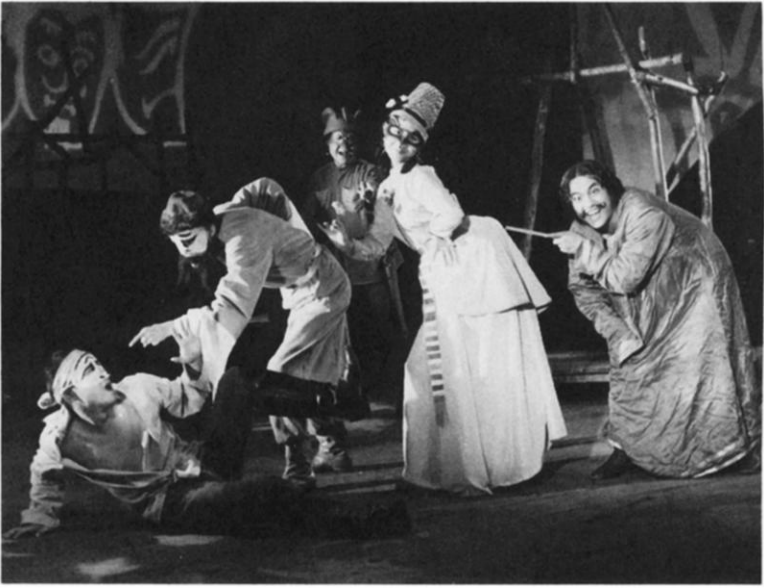
Theater in China was born out of intercultural exchange and evolved when it was developed by Chinese actors and directors. For example, opera and spoken drama often worked together to develop a plot or certain message: “A spoken drama begins-and in it a battle is fought. For that scene, the techniques of opera are used, and then the production goes back to being a spoken drama” (Jia-Xuan, Schechner, 97). Furthermore, directors: “borrowed techniques from Chanju, Sichuan opera, and produced a fantastic combination of traditional opera and spoken drama” ( Jia-Xuan, Schechner, 98).

After the founding of the People’s Republic of China in 1949, spoken drama became more popular, scripts became more abundant, and more people began to work in theater. During the Cultural Revolution, spoken drama barely survived. The evolution of spoken drama and performances into the hands of Mao Zedong serve as models of and for what he wanted to communicate to the people about his regime. Mao Zedong: “attempted to revamp the spoken drama as another vehicle for disseminating Communist ideology, publicizing Communist policies, and mobilizing popular support” (Houn, 223).
Structural Reform and Transition
Chinese Communists began to turn Chinese drama into a modernizing and communizing weapon from the moment they occupied power in 1949 (Liu, 20). While it grew increasingly censored throughout the regime, the initial theatrical reform was vague and relatively non-threatening: “The local cadres were instructed to ban those plays that had superstitious, feudal or anti-proletariat themes. The interpretation of these terms was left to the local cadres” (Liu, 20). However, Mao and his party urged playwrights to praise the regime through performance and new scripts (Liu). In some areas, theaters were forbidden to show traditional drama of any kind, whereas other local officials gave their theaters permission for a ‘free hand’ (Liu, 21). These unspecific and loose instructions resulted in chaos.
State control of theatrical groups and performance became increasingly strict and censored through constant policy reform, especially after Mao Zedong delivered his famous speeches on the problems of literature and arts (Houn, 225). Local cadres, police officers, cultural bureaus and garrison headquarters all took part in the task of repertorial reform. Some localities issued nothing but spoken dramas composed exclusively by Communist of pro-Communist writers (Houn, 227).
The numerous and controversial waves of drama reform produced many problems: “The Communist Party claimed that the traditional Chinese drama was the product of the ‘feudal past’, but it also declared that the Chinese drama is a fine legacy of the nation’s culture” (Liu, 24). Communists were forced to question the role of morals in spoken drama because some of the historical ‘morals’ featured in traditional Chinese plays were not compatible with this new regime (Liu). The party’s idea of “weeding through the old to let the new emerge” was not going to work (Liu). The Communist Party faced difficulty in creating new plays using traditional techniques and failure in successfully using the stage as propaganda.
Objective
Mao’s problems with literature and arts, along with the tightening reforms for drama outlined the overall objective of the regime and its use of the stage for conducting propaganda and indoctrination. Mao and the party believed that: “any expression of Communist ideology and political tenets should be in a form that is capable of reaching the broadest masses and is widely enjoyed by them” (Houn, 225). The reform work was defined by its devotion to awakening the political consciousness of the people, stimulating the production on the part of the playwrights, and praising the new personalities and events of the era (Houn). Additionally, the use of the stage as propaganda was only one of many the mediums that were used to portray the nation as a powerful socialist country with high levels of cultural and democratic development.
Model Theater
Mao Zedong had a strict code of conduct for drama. Drama groups and theaters were forced to submit performance schedules and submit them for approval. State-controlled groups were required to spend six months or more per year giving public performances in theaters, along with two months on mobile shows in factories, villages, and army units. All private theatrical groups had to register with the authorities in charge of cultural art fairs and then submit an application for approval of giving performances to provincial or municipal authorities in charge of cultural affairs (Liu, 22). Dramas that portrayed glimpses of (what Mao deemed) feudalistic morality, cruelty, horror, and obscenity were banned. However, Mao did have an idyllic form of drama, Model Theater, which promoted anti-aggression, anti-oppression, love-motherland mentality, love-freedom mentality, love-labor and righteousness (Liu).
Mao’s support for Model Theater: “was motivated by the intention to prove that proletarian art was possible, and in fact, very desirable” (Chen, 59). Additionally, Model Theater is important and useful when looking at the changes that theater underwent during the Cultural Revolution: “it represented, distinguished negative and positive characters along class lines and according to their family relationship to the Communist revolution before 1949” (Chen, 59).
The difference between Model Theater and traditional theater can be seen when looking at their respective plays and scripts. Traditional Chinese drama was centered around family relationships and love stories and was adored due to its closeness to real life (Chen). The love displayed in these spoken dramas and performances stand in direct contrast with the Communist Party’s overarching objective/message: they were interested in emphasizing love for labor, love for the regime, and love for the motherland. PRC theater displaced family, love, and culture that was so central to Chinese tradition: “model theater virtually eliminated family and love relationships…The theatrical conventions such as the shapely bodies of the female characters, their dramatic gestures in acting, singing, dancing and their more-colorful-than-real-life costumes, however, imbued women with a visual power that could sometimes subvert the verbal texts to assert their separate identities, limited as they might be” (Chen, 108). The plays of the PRC distanced themselves from the visual spectacle and honed in on the message of the regime. Wangi’s play: Never Forget Class Struggle (1960) is a perfect example of this. It depicts workers’ families to ensure that the younger generation would always remember their fathers’ and grandfathers’ sufferings in the old society (Chen, 108).
War Theater
Taking Tiger Mountain by Strategy is an example of Communist China’s War theater and one of the eight model plays. It emphasizes the military thought of Mao Zedong and his regime. Having a role in this drama raised the status of an actor to a prime role in the military. Red Army soldiers made political use of the theater because drama and the stage were used as a: “weapon to incite conflict” (Meserve, 315). While these war propaganda performances lacked “artistic subtleties” and “imaginative expression”, they were effective in successfully driving home an important message to viewers (Meserve, 317). This theater was a functional part of China’s military machine: “the theatrical performances helped to keep many people–soldiers and civilians alike–inspired and motivated toward conflict” (Meserve, 317). They were strictly propaganda plays that followed the ‘correct’ political theories of a proletarian state, employed by Mao as effective ideological weapons. These dramas reflected army life and nationalistic pride, adhered to the party’s beliefs, and overwhelmingly portrayed political concepts dictated by the Communist Party and Mao Zedong.
Reactions/Problems
Actors and theater troupes were no longer seen as makers of meaning, but rather a “group of cultural and artistic workers who have the responsibility and honor of educating the people” (Houn, 230). They were no longer free to use the stage as a medium for their expression but were instead slaves to the regime and its objective. The title of an actor/actress had acquired a negative connotation, especially in comparison to their regard in traditional Chinese theater. They were no longer praised for their work. They were seen as “teachers of the people” (Houn, 230). Furthermore, local theater suffered from a lack of scripts from unenthused playwrights due to heavy reform. Pro-Communist Party members took their place instead, and most of them knew nothing about playwriting.
There was an obvious lack of enthusiasm for performance under the Communist regime, so they decided to provide an incentive to the acting profession through giving actors membership in the New Democratic Youth Corps and the Communist Party. These memberships provided an opportunity for recognition, along with material advantages and political prestige (Houn). However, these honors and special treatment were undermined by the overarching discontent and uneasiness of the Chinese stage (Houn, 231). This is evidenced by a well-known actor, Yeh Sheng-ch’ang during a symposium in 1957, saying that the Communist officials: “behaved like dictators, making decisions arbitrarily and demanding absolute obedience. Incompetent but subservient actors and actresses were promoted, [said Yeh], whereas capable and self-respecting ones were usually discriminated against” (Houn, 231). Furthermore,non-Communist actors were treated as criminals that were to be pushed around and humiliated. The famous actor even went on to say that if the theater could not be trusted by the regime, then they might as well liquidate the medium all together (Houn).
The Chinese Communists had major difficulty in utilizing spoken drama for successful political purposes. Early on, these plays: “drew large audiences, ran for weeks at each theater, and won prolonged applause” (Houn, 232). However, as the regime grew in power and censorship, the Communists found that spoken drama had lost most of its public appeal. There were few ‘successful’ plays that were written by Communist playwrights. The White-haired Girl aimed at exposing the crimes of the landlords before Communism. The conflict of the play is resolved by an influx of Communists in the play’s village. The landlord is sent to death for his crime after an announcement: “The old society forced human beings to live as ghosts, but the new society has transformed ghosts into human beings, and brought salvation to many of our good, long-suffering sisters” (Houn).
In The White-haired Girl, ragged peasant clothes and Red Army propaganda replaced fancy traditional costumes. Traditional facial make-up had been eradicated. New stage settings and lighting were used to strip the performance down to the bare minimum. It was perceived as incomplete and inconsistent because of the clashing of modern costumes and new techniques while actors sang traditionally (Liu).
Spoken drama faced constant obstacles and disappointment under Mao Zedong. They were: “overwhelmingly one-act plays dogmatically portraying the new life of Chinese people, zealously paying high tribute to the Communist regime, and passionately calling upon the population to make greater exertions in the building of a socialist society” (Houn, 233).
The problems only grew worse. Pro-Communist scripts, playwrights, and performances were heavily criticized due to: “their lack of a thorough grasp of Marxism, Leninism, and the thought of Mao Tse-tung and to their failure to make close observation and earnest analysis of the actual life of the people” (Houn, 234). However, the problems, exploitation, and corruption of spoken drama cannot be isolated to just this. There were many other issues. There was a lack of guidance and constructive criticism by the authorities to help playwrights. Censorship and theater management: “were sometimes captious in passing on the ideological fitness of play scripts” (Houn, 234). Playwrights were denied the right to collect royalties. Publishers were afraid and refused to adapt longer plays for the stage. There were several conferences regarding reform to promote playwriting and re-adjusting the Chinese stage, but ultimately it was a lack of good scripts that remained the major obstacle for successful propaganda.
Conclusion
As time went on and the Cultural Revolution was declared over, new critics expressed opinions that were more severe by: “directly attributing all the shortcomings and mistakes in the spoken drama field to the party leadership” (Houn, 235). Famous playwright Wu Tsu-kang even went on to more severely express the regime’s crippling effect on spoken drama: “the party’s rigid control of dramatic expression lies at the roots of subjectivism, dogmatism, sectarianism, and bureaucratism in theatrical work” (Houn, 235). Mao Zedong and the Communist Party made art and literature in China suffer from his ideologies in a way that suffocated theater to the point that it nearly died. While he was able to temporarily manipulate and exploit it, the stage under Chinese Communism embodies the regime that was brought to an abrupt halt by the cultural performance of the Tiananmen Square Protests of 1989.

Bibliography
Text Sources:
Chen, Xiaomei. Acting the Right Part: Political Theater and Popular Drama in Contemporary China. Honolulu: U of Hawai’i, 2002. Web. Apr. 2017.
Houn, Franklin W. “The Stage as a Medium of Propaganda in Communist China.” Oxford Journals 23.2 (1959): 223-35. JSTOR [JSTOR]. Web. Apr. 2017.
J., Walter, and Ruth Meserve. “Communist China’s War Theatre.” The Journal of Popular Culture VI.2 (1972): 313-24. Wiley Online Library. Web. Apr. 2017.
Jia-Xuan, Zhang, and Richard Schechner. “Speaking about China’s Spoken Drama: A Roundtable with Chinese Directors and Playwrights.” TDR (1988-) 33.2 (1989): 87. The MIT Press. Web. Apr. 2017.
Liu, Alan. The Use of Traditional Media for Modernization in Communist China. Rep. Cambridge: Massachusetts Institute of Technology, 1965. Web.
Audio-visual Sources:
Figure 1. Iggers, Dan. The People’s Liberation Army is the University for Mao Tse Tung Thought!. Mar 24. 2005. Flickr, https://www.flickr.com/photos/fortinbras/7319861. Accessed 17 Apr 2017.
Figure 2&3. Zhigang, Cao. Caucasian Chalk Circle. 1985. China Youth Art Theatre. Speaking about China’s Spoken Drama: A Roundtable with Chinese Directors and Playwrights, Zhang Jia-Xuan and Richard Schechner, The MIT Press, 98.
Figure 4. “White Haired Girl Ballet, 1964 (Film 1971): A Different Overture, Dockside Workers…” Youtube, James P, 01 Oct 2012), https://www.youtube.com/watch?v=tcs2aoL1ewE.
Figure 5. Mandiberg, Michael. Tiananmen Square Protest. June 2, 2009. Flickr. https://www.flickr.com/photos/theredproject/3590746689. Accessed 17 Apr 2017.
