Overview
As the longest surviving theatrical form in the world, Japan’s noh theater has continued to entertain audiences since the 14th century. Noh is characterized by its masterfully crafted masks, elaborate costumes, and highly technical form.
History
Noh theater, along with its close relative, kyogen theater, emerged from sangaku, a form brought to Japan from China during the 8th century (the Nara period). Sangaku itself was not a theatrical form, but rather a collection of different performances, such as acrobatics, dancing, and music. As sangaku merged with the existing Japanese performance arts, it took on a comedic form, which would later evolve into kyogen. Because of its comedic nature, sangaku was renamed sarugaku (‘comical’).

After sarugaku was integrated into Japan, it became used as entertainment at religious rites for centuries. Because of this, sarugaku would be performed at temples or shrines. Performers of sarugaku were organized into troupes, much like noh was — and still is. Kan’ami Kiyotsugu (1333-1384), a member of one of the four sarugaku troupes in Yamato no Kuni (present day Nara, Japan), was a renowned actor who is now known for creating noh as we know it today. Kan’ami brought singing and dancing from another notable performance art in Japan, dengaku, into sarugaku performance during the 14th century.
After Kan’ami and his son Zeami Motokiyo (1364-1443) performed for Ashikaga Yoshimitsu, a shogun of the Muromachi shogunate, both Kan-ami and Zeami were patronized and aristocrats began to enjoy the performance of both sangaku and dengaku. From there, Zeami began to refine the performance style until he finally created noh. Kyogen, which began to be performed alongside noh, evolved around the same time that noh did.
Not long after Zeami’s nephew and son-in-law became his successors, Japan was plagued by civil war, so sarugaku troupes lost their patronage. Noh, however, became popular along commoners, and thus continued to flourish. As the Muromachi shogunate declined, noh was revitalized by warlords who ensured the continuation of noh troupes. Thanks to the growing economy of Kyoto and Osaka and more technological advances, noh costumes became much more elaborate. At this point in time, around the 15th and 16th centuries, aspects of noh performance such as staging and masks had completed the process of perfection and standardization.
Since its creation, noh theater has consisted of plays created by the actors themselves. Though noh theater is strict in its form, it has nonetheless continued to evolve over the centuries since its creation, as each generation continues to refine the performances.
Aspects of Noh Performance
Stage
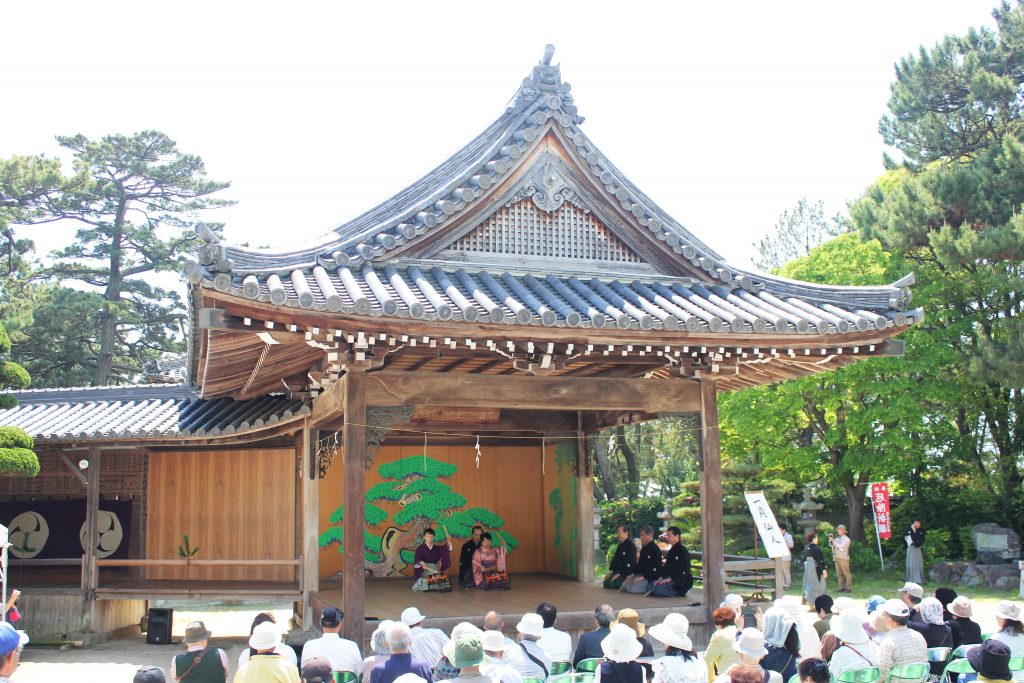
At the beginning of Japanese theater history, most performances were simply staged on the ground. Then, noh plays began to be performed at the same shrines that were used for sacred kagura dances. The noh stage that is still used today can be either outdoors or inside. The stage remains an independent roofed structure, even when constructed indoors, with the roof held up by four pillars. A bridgeway leads from the back left-hand corner to the mirror room, from where actors change and then walk onto the main stage. The floor is constructed out of Japanese cypress wood. Along the perimeter of the stage, white gravel is placed to replicate original outdoor noh theaters, which used gravel to reflect natural light onto the stage.
The stage has no scenery except for a single pine tree, which is painted on the back wall. Pine tree is seen to be sacred, where someone can encounter “the spiritual forces of nature.” Three pines are placed along the outside of the bridgeway. Three steps, which were used in the past but are now simply decorative, lead down from the front of the stage. The lighting is constant and simple – that is, with any effects or different colors – in order to mimic the lighting conditions of theater before electricity. Seating used to consist of cushions, but most use chair-type seats today.
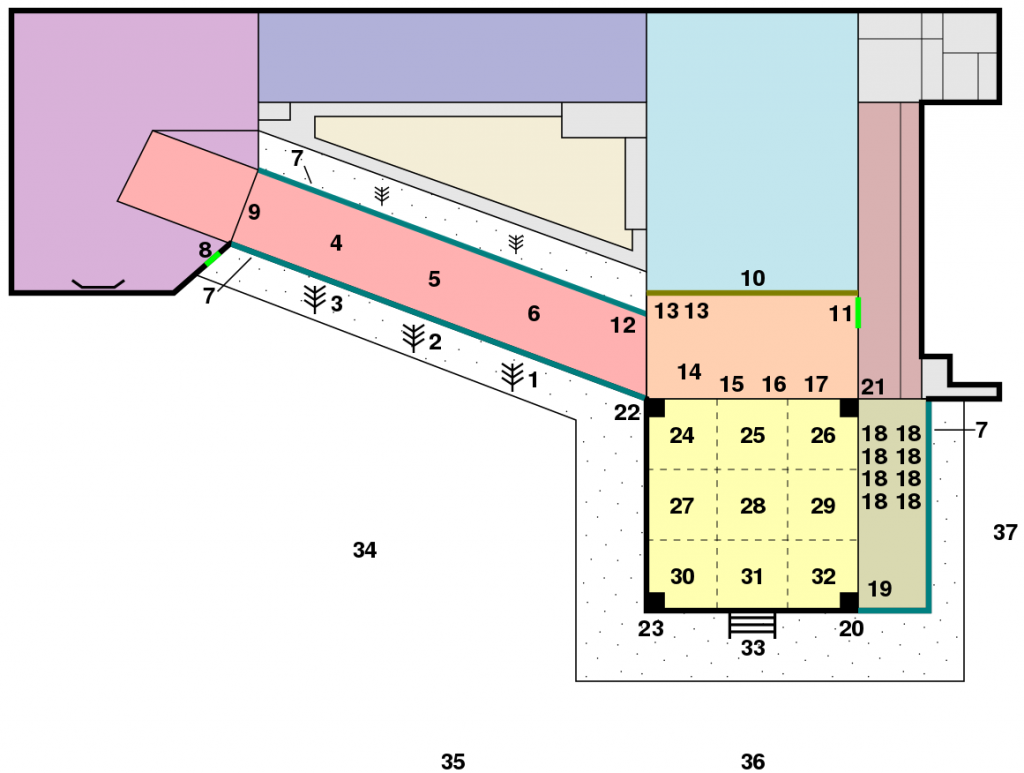
1.First pine 2. Second pine 3. Third pine 4-7. Bridgeway 8. Entrance to mirror room 9. Curtain 10. Pine backdrop 11. Side door 12. Kyogen seat 13. Stage Assistants 14. Stick Drum 15. Hip Drum 16. Shoulder Drum 17. Flute 18. Chorus 19. Waki seat 20. Witness pillar 21. Flute pillar 22. Base pillar 23. Corner pillar 24. Base square/shite spot 25. Back center/before drums 26. Back corner/before flute 27. Right center 28. Center stage 29. Left center/before chorus 30. Corner 31. Front 32. Waki spot/ witness square 33. Stairs 34-36. Audience
Actor Roles
Waki and Wakizure
The waki is usually the first person to appear onstage. Waki means “person on the side” or “witness.” The waki character is almost always a human male, as opposed to the shite, who tends to be an otherworldly character. The waki can be a minister, a priest, or a common man (a warrior, townsman, or villager). Because he is a regular human, the waki does not wear a mask.
The first thing the waki does onstage is announce himself through his “self-introduction.” His primary purpose is to call the shite, the main actor, onto the stage and incite him to act. After he has completed his role, the waki usually watches the shite from the corner of the stage in order to let the shite be the sole focus. The waki is often accompanied by companions or attendants called wakizure (“companions to the waki”). Waki actors never perform shite roles, and shite actors never perform waki roles, as each actor is trained only in one role. He can speak in both verse and prose, but his self-intro is in prose.
Shite and Tsure
The shite is the most important character in all noh plays constructed in the traditional form. He is the center of attention, and all other characters make sure that they do not outshine him. The shite is usually an otherworldly creature. Because of this, the shite almost always wears a mask, except when playing a regular human, which is rare. The shite may be subdivided into maeshite, “shite in part one,” and nochijite, “shite in part two.” To match the magnificence of the role, the shite usually speaks in verse. Most of the shite’s sung passages use classical Japanese poetry meter: alternating 5- and 7- syllable lines. Sometimes the shite has a companion called tsure, meaning “one brought along.” Tsure figures can be masked but the mask is not usually as nice as the shite’s.
Jiutai (Chorus)
The chorus sits on the right side of the stage and usually consists of eight to ten people.It has no defined identity of its own, instead singing to set the scene, to describe the emotional state of waki characters, or to interact with the shite or the waki. Its lines are either lyrical, sung prose, or verse.The chorus consists entirely of shite actors.
Kokata
The kokata is a role for children and is always played by boys – mostly sons of professional shite actors learning to become professionals themselves. The kokata can either play a child character or an adult character. For example, kokata can play high-ranking adult characters, such as an Emperor, to be symbolic of innocence. Another reason a child might play a character such as an emperor – a waki character – would be so that the waki does not outshine the shite.
Koken (Stage Assistant)
The koken, or stage assistant, helps the shite by adjusting his costume, handing him props, and taking away props once they are done. The koken is also a shite actor and will take the place of the shite actor in the play if he cannot complete the performance.
Ai
The main function of the ai is to perform the interlude between parts one and two of a two-part play, filling interval while the shite actor changes. The ai is not a noh actor at all, but a kyogen actor. The ai can explain what has happened in the performance and/or perform a scene to provide comedic relief. In one scene plays, the ai can appear at the beginning of the play. Sometimes, he can even be present throughout the play.
Music and Instrument
The orchestra in a noh performance consists of a flute (nōkan), shoulder drum (kotsuzumi), hip drum (ōkawa), and stick drum (taiko). The orchestra sits at the back of the stage in front of the pine tree backdrop, with the musicians sitting in a specific order from stage left to right: flute, shoulder drum, hip drum, stick drum. The stick drum is present in most, but not all, plays.
Masks and Costume
Masks
Masks are a staple of noh performance. Noh masks are first carved out of wood, usually Japanese cypress, and then painted. The masks themselves are pieces of art, being masterfully crafted and passed down for generations. The shite wears a mask in almost every play, setting him apart as a special, larger-than-life character. Noh masks vary in appearance depending on the type of character whom the shite is playing. The masks pictured below, for example, represent two of the different personas a shite actor can take on; the mask on the left is an “enraged soul” mask, while the mask on the right is a “lovable girl” mask. The masks that depict the same archetype, such as a demon or a girl, tend to be similar in appearance, though masks can vary slightly in look and craftsmanship based on the school they come from. These particular masks come from the Konparu school and are two of the forty-seven masks which were owned by a renowned noh acting family, the Konparus, for centuries.

Fig. 4: Enraged Soul 
Fig. 5: Lovable Girl
The act of putting on the noh masks symbolizes a complete transformation for the actor. Once the shite actor dons the mask, he becomes the character inside and out. The actor himself chooses the mask that fits the way that he decides to portray the character. The masks themselves are not meant to have much expression, as it is the role of the actor to bring the character to life through his acting. Specific movement patterns are used accentuate things such as gender or emotions.
Costumes

Like the masks, noh costumes are pieces of art in and of themselves. The costumes in noh performance are called shozoku. The colors, patterns, and ways in which each kimono is worn is governed by strict rules depending on what type of character the actor is depicting. Even if the character is poor, the costumes are still ornate. The costume depicted below is just one example of the many beautiful patterns a noh actor might wear. Underneath the elaborate costume is white underwear and tabi socks, which separate the big toe from the other four toes. Directly underneath the kimono is a plain silk piece of clothing and a collar whose color represents the social status of the character. The actor will sometimes put on a wig, a headdress, and other accessories depending on the role.
Noh actors will often carry fans, much like the actor in the photograph is doing. These fans not only add to the beautiful of the costumes, but also serve as actual props in the performance. Like the costumes, the pattern of the fan is determined by the type of character who will be holding it.
Movement
In noh performance, movement is vital to understanding both the type of character that is being portrayed and the emotions of said character. For example, the noh actor positions his body in a specific manner so as to inform the audience whether he is playing a man, woman, or another being entirely.
Standing
All noh actors stand with their knees slightly bent while keeping their body stable. An actor portraying a woman will hold his arms closer to his sides than an actor portraying a man would. Both male and female characters keep their feet close together, though a male character will have his feet pointed slightly outward. An actor portraying an ogre, however, has an exaggerated stance, with his arms even farther away from his sides than a male character, with this legs about shoulder-width apart.
Walking
Noh movement is so specific that even the way that actors walk is standardized. The way noh actors walk is called Hakobi, and it involves the actors moving their feet without lifting their heels off the ground. The noh actor thus slides his feet across the floor as he navigates the stage. In the video near the bottom of the page, one can see how the shite actor only lifts his heels up slightly as he glides around the stage.
Showing Emotion
Because shite actors wear masks, they display their emotions through specific movements that the audience would understand. For example, when a character is meant to be crying, the actor will slowly lift his hand up towards his forehead with his palm towards his face. The actor will use both hands if he wants to intensify the crying.
Performance Structure
Play Categories
The formal structure of a full program is five individual noh plays and four individual kyogen plays. The plays performed alternate between noh and kyogen, with a noh play beginning the program and a noh play ending the program. In a full program, the five categories of noh plays are performed in a set order:
- Waki Noh, or god play. In the god plays, the shite is a god, or sometimes a demi-god.
- These are two-scene plays. In the first scene, the shite will often detail the origin of a religious place. In the second scene, the shite returns as the god of the aforementioned religious space and dances.
- Shura Mono, or warrior/ghost play. In this type of play, the shite is a warrior who has died but continues to fight in death.
- In these plays, the shite tells the waki, a priest, of his last battle and asks the priest to pray for him.
- Katsura/Kazura Mono, or woman/wig play. The shite is a woman in these plays.
- These plays are considered the most elegant and beautiful of all noh plays. One example of such a play, Matsukaze, is described in detail in the “A Popular Noh Play” section of this page.
- Zatsu Noh or Kyojo Mono, or miscellaneous or mad woman play. This category is made up of miscellaneous plays but is mostly known for its mad woman plays.
- This type of play can have many different subjects, but they all include a mad character. Many Zatsu Noh plays follow the story of a mother driven mad by the death of her child.
- Kiri Noh or Kichiku Mono, or concluding play or demon play. The last play in the program, the shite is usually a demon or demon-like creature.
- These plays often have a fast tempo. Kiri Noh plays consist of two scenes; in the first, the shite appears to be human, and in the second, the shite reveals his true demon form. Depending on the play, the demon can be either good or bad. When the demon is good, he blesses mankind. When the demon is bad, he is defeated in the end.
Typical Play Structure
A typical noh play begins with an empty stage. The audience then begins to hear the performers tuning their instruments, indicating that the play is about to begin. The musicians come onto the stage and take their place at the back, followed by the entrance of the chorus, who enter from the small door at the back right of the stage. If the play requires larger props, the koken, or stage assistant, will bring them out.
After the musicians, chorus, and props are in place, the waki enters from the mirror room, walking through the bridgeway to the main stage. There, the waki introduces himself, telling the audience who he is, where he has come from, where he is now, and why he has come to the place that he has.
After the waki completes his self-introduction, he sits down and the shite comes onto the stage. In two-scene plays, the shite begins as the maeshite in the first scene and then changes his costume and mask to become the nochijite in the second scene. If the waki or shite have companions, they will also be present onstage. When he arrives on the main stage, the shite makes a speech, usually in the form of a song, that explains who he is and why he is important to the story. The shite also usually answers questions from the waki at this time.
When the first scene has ended, the shite exits and the ai appears during the interlude, usually to explain what has happened or provide comic relief. Then the shite returns as the nochijite, showing his true self. At this point, there is usually a dance or other climatic scene. When the action has been completed, the shite exits first, followed by the waki, props, musicians, and chorus. The empty stage signals the end of the performance.
A Popular Noh Play
Matsukaze, or Pining Wind, is a very popular play by Kan’ami which was later revised by his son, Zeami. Matsukaze is a Katsura Mono, or a woman play, in which there are two main characters, the ghosts of two saltmaker sisters named Matsukaze (the shite) and Murasame (the tsure). The two sisters were in love with an exiled nobleman, Yukihira, who died and for whom they still mourn even as spirits.
At the beginning of the play, a traveling priest (the waki) arrives to Suma shore, where the two sisters lived. The priest sees a pine tree that is on the beach — a strange sight — and asks a villager (the ai) about it. The villager tells the priest that it is the memorial for the two sisters, who had both loved Yukihira.
The two sisters then come onto the stage with buckets and reflect on their lives, the scenery, and their love of Yukihira through song. When the two sisters arrive home, the priest comes to ask for lodging, and they accept. Once inside, the priest talks to the sisters, bringing up Yukihira, the pine tree, and the story the villager told him about the sisters. The women begin to cry, and then they reveal that they are in fact the two sisters whom the pine tree memorializes. In her grief, Matsukaze dresses in Yukihira’s old clothes, dances, and embraces the pine tree. When morning comes, the two spirits disappear, and the play comes to a close.
Noh Today
To this day, noh continues to be passed down to new generations of actors. Noh is still largely hereditary, meaning that families have passed the tradition down to their children for generations, and younger noh actors are usually descendants of past noh actors. For centuries, noh theater was performed exclusively by men. Since 1947, however, women have been legally allowed to perform professionally, though coed casts are fairly infrequent and most women perform either in all-female groups or as amateurs.
One major problem facing noh actors today is that most can no longer support themselves through their acting alone. Shite actors will often earn additional income by teaching new students, while waki actors and musicians find it hard to earn a living this way due to the lack of waki and musician students.
Because of the enthusiasm of actors and audiences, noh continues to thrive in Japan. In Nara, the birthplace of noh, performances are still staged at the Kasuga Wakamiya On-Matsuri, a festival, each December. The community of noh actors strives to instill new life into noh theater through the creation of new plays and the revival of old ones. In 1983, The National Noh Theater was built in Tokyo, and in 2008, noh theater was inscribed on the UNESCO Representative List of the Intangible Cultural Heritage of Humanity, which aims to preserve and raise awareness about diverse cultural practices throughout the world. The enduring love and support of noh theater will be key in ensuring noh’s existence for generations to come.
Works Cited
Text
Brazell, Karen. “The Noh and Kyogen Theaters.” Traditional Japanese Theater: An Anthology of Plays, Columbia University Press, 1998, pp. 115–300.
Harris, John Wesley. The Traditional Theatre of Japan: Kyogen, Noh, Kabuki and Puppetry. The Edwin Mellen Press, Ltd., 2006.
“Invitation to Nohgaku.” Invitation To Nohgaku, Japan Arts Council, Mar. 2018, www2.ntj.jac.go.jp/unesco/noh/en/. Accessed 23 March 2019.
Maruoka, Daiji, and Tatsuo Yoshikoshi. Noh. Translated by Don Kenny, Hoikusha, 1996.
Nakamura, Yasuo. Noh: The Classical Theater. Translated by Don Kenny, Walker/Weatherhill, 1971.
Tyler, Royall. Japanese Nō Dramas. Penguin Books, 2004.
Images
Fig. 1: Maki_C30D. “The Mask.” Flickr, 10 November 2006, https://flic.kr/p/s5yGU. Accessed 22 April 2019. Licensed under CC BY-NC-ND 2.0.
Fig 2: 藤谷良秀. “Noh Theater at Sumiyoshi-Jinjya (Akashi).” Wikimedia Commons, 1 May 2016, commons.wikimedia.org/wiki/File:Noh_theater_at_Sumiyoshi-jinjya_(Akashi).jpg. Accessed 23 March 2019. Licensed under CC BY-SA 4.0.
Fig. 3: Sabunero. “Noh stage.” Wikimedia Commons, 9 April 2012, https://commons.wikimedia.org/wiki/File:Noh_stage.svg. Accessed 7 April 2019. Licensed under CC BY-SA 3.0.
Fig. 4: Kakidai. “Nō mask – Hannya Type.” Wikimedia Commons, 1 October 2015. https://commons.wikimedia.org/wiki/File:N%C5%8D_mask_-_Hannya_Type.JPG. Accessed 7 April 2019. Licensed under CC BY-SA 4.0.
Fig. 5: Kakidai. “Nō mask – Koomote Type.” Wikimedia Commons, 1 October 2015. https://commons.wikimedia.org/wiki/File:N%C5%8D_mask_-_Koomote_Type.JPG. Accessed 7 April 2019. Licensed under CC BY-SA 4.0.
Fig. 6: Aleksandar Bondikov. “Kyutaro Hashioka.” Flicker, 27 September 2014, https://flic.kr/p/p9dih6. Accessed 7 April 2019. Licensed under CC BY 2.0.
Video
Deveykin, Andrey. “Japanese Noh / Японский театр Но / 能.” Youtube, 16 May 2014. https://youtu.be/y0qifackwwg. Accessed 7 April 2019.


